Once the capital of an ancient kingdom, Mtskheta is where Georgian history and Orthodox faith run deepest.
Here's what to see, feel, and eat on a day trip from Tbilisi.
[Twenty kilometers north of Tbilisi](/en/blogs/tbilisi), the road narrows, the pace drops, and suddenly you're standing in a city that was already old when Rome was still building its empire.
Mtskheta was the capital of the early Georgian Kingdom of Iberia for roughly a thousand years before Tbilisi took over in the 5th century AD. Today it holds UNESCO World Heritage status — but more than any official label, locals simply call it the spiritual heart of Georgia. You'll understand why the moment you step inside Svetitskhoveli Cathedral.
Svetitskhoveli Cathedral
Built in the 11th century on the site of Georgia's first church, Svetitskhoveli (say it slowly: sveh-teets-kho-VEH-li) is not just a cathedral — it's a national landmark that Georgians treat with genuine reverence. The name means "Life-Giving Pillar," and according to tradition, a piece of Christ's robe is buried beneath it. Whether or not you're religious, the weight of that belief is palpable inside: candlelight, low chanting on a good day, the smell of incense, and centuries of carved stone overhead.
Look closely at the exterior walls. You'll spot animal reliefs, Georgian inscriptions, and a sculpted arm holding a set square — said to be the hand of the architect. He didn't sign his name; he signed his trade.
Practical tip: Entry to the cathedral grounds costs around 3 GEL. Dress modestly — shoulders and knees covered — or borrow a wrap at the gate.
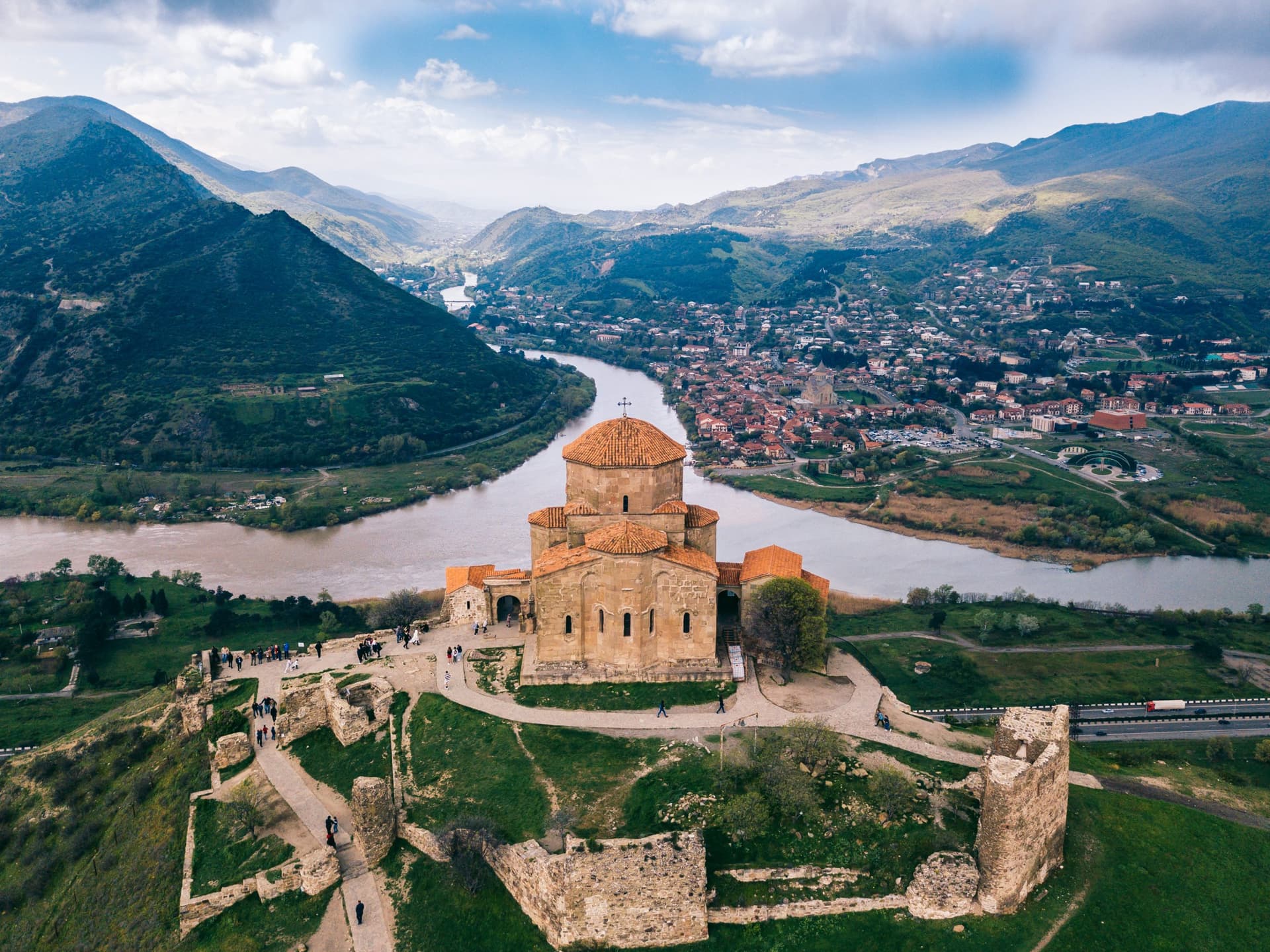
From the cathedral, look up toward the hill to the east and you'll see it: Jvari Monastery, perched on a rocky ridge above the town. Built in the late 6th century, it's one of the oldest surviving Georgian churches, and the view from up there is the reason half the photos of Mtskheta exist. The two rivers — the green Aragvi and the murkier Mtkvari — meet directly below, and the geometry of it feels almost deliberate.
Jvari is a short drive or a punishing uphill walk. Take the road if you're short on time; walk it if you have an hour and good shoes. The monastery itself is small and unadorned inside, which somehow makes it more powerful. No gift shop, no crowds pressing in — just old stone and wind.
The Town Between the Monuments
Mtskheta's old town is compact enough to walk end-to-end in twenty minutes. The main street, Davit Aghmashenebeli, is lined with souvenir stalls selling churchkhela (walnut-stuffed grape-juice candy shaped like a sausage — try the dark, wine-heavy variety), embroidered tablecloths, and the usual tourist trinkets.
For lunch, duck into one of the family-run restaurants just off the main drag. A bowl of chikhirtma (tangy chicken broth thickened with egg and vinegar) and a plate of lobiani (flatbread stuffed with spiced kidney beans) will run you 15–20 GEL and keep you going for the rest of the afternoon.
Getting There
The easiest option from Tbilisi is a marshrutka (minibus) from Didube bus station — about 1.50 GEL, roughly 30–40 minutes. Taxis from central Tbilisi cost around 25–35 GEL one way. Most people visit as a half-day trip, though if you want to catch the light on the Jvari ridge at golden hour, it's worth staying into the evening.
Share:
Travel Tips
•Marshrutkas to Mtskheta leave from Tbilisi's Didube station; the fare is ~1.50 GEL. No fixed schedule — they go when full.
•Jvari Monastery and Svetitskhoveli are 3 km apart — rent a car or negotiate a waiting taxi rather than walking the road between them.
•Both sites require modest dress (covered shoulders and knees). Wraps are available at the gate but it's faster to come prepared.
•Come on a weekday morning to avoid school groups and tour buses — Svetitskhoveli gets crowded by midday on weekends.